Pluto's Planetary Status: Unraveling the Controversy Surrounding Pluto

Overview
1930
Clyde Tombaugh discovered what was deemed ‘Planet X’ on February 18, 1930. After confirming the discovery, news was telegraphed to the Harvard College Observatory on March 24, 1930, and was later named 'Pluto' by Venetia Burney.
"Pluto was discovered in 1930, as this object was an oddball compared with its solar system buddies in its eccentric orbit, small size and low mass… some argued, then, that Pluto didn't fit in with the rest of the solar system planets.” —Jeanna Bryner, Space.com

Venetia Burney Phair. (Solar System Exploration, 2022)
1992
Despite minor confusion concerning Pluto’s classification, most went unnoticed until 1992, when the first Kuiper Belt Object (KBO) was discovered. After this, discoveries began coming in at an ever-increasing rate.
“The view of our Solar System's landscape began to change on August 30, 1992 with the discovery by David Jewitt and Jane Luu from the University of Hawaii of the first of more than 1000 now known objects orbiting beyond Neptune in what is often referred to as the transneptunian region.” —IAU
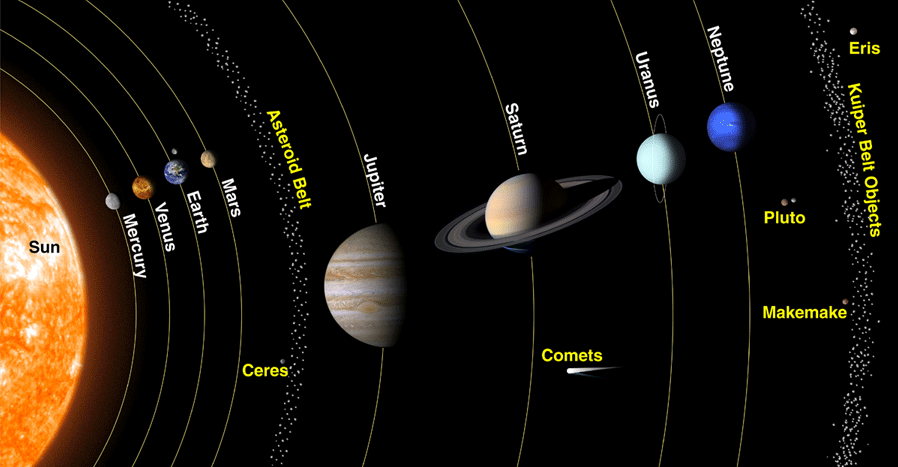
Kuiper Belt in the solar system. (Forbes, 2018)
1993
In 1993, Brian Marsden correctly observed that Pluto shared more similarities with KBO’s than with the other eight planets. This pointed out the need for a classification system that categorized solar system objects based on similar characteristics.
“More specifically, he [Brian Marsden] was the first to suggest, correctly, that three transneptunian objects discovered in 1993 were exactly like Pluto in the sense that they all orbit the Sun twice while Neptune orbits it thrice. This particular recognition set him firmly on the quest to "demote" Pluto.” —J. Kelly Beatty, Sky and Telescope

Brian Marsden, pictured above. (Sky and Telescope, 2010)
“More than 1,300 KBOs were discovered between 1992, when the belt first was identified, and 2014.” —Keenan Marie, Space Science/Astronomy: Celestial Bodies (add another date as 2014?)
"The old "I-know-it-when-I-see-it" definition [of a planet] had come under fire for a variety of reasons, including the growing number of Trans-Neptunian objects found in the Kuiper belt and beyond." —Ethan Siegel, Forbes
2003-2005
When astronomer Mike Brown discovered Eris on October 5, 2005, from information dating to October 21, 2003, it set off the entire debate. It all boiled down to the question, what was a planet exactly? Many scientists began proposing extremely different ideas, and many heated debates took place. The truth was, they were trying to classify objects that they didn't know the classification for.
"A team of researchers at the Palomar Observatory, a research center operated by the California Institute of Technology (Caltech) outside San Diego, California, imaged 136199 Eris in 2003. Astronomer Mike Brown and his team conducted nightly surveys of the Kuiper Belt, a disk-shaped region of space beyond the orbit of Neptune….The team first photographed Eris, then called 2003 UB313, on October 21, 2003. They confirmed the discovery in January 2005 and submitted the object to the International Astronomical Union (IAU) for consideration as the tenth planet of the solar system." —Marie Keenan, 136199 Eris
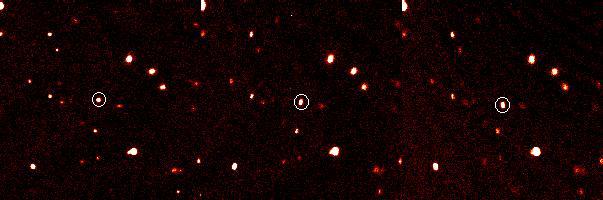
Eris drifting across the sky. (Jet Propulsion Laboratory, 2003)
“The Pluto controversy boiled up when Eris came up, because you couldn't leave things the way they were... You really had to contort things to say Pluto was a planet and Eris wasn't. Things really came to a head.” —Jack Lissauer from NASA's Ames Research Center, Space
"The discovery was to have a serious impact on astronomical science. It forced the scientific community to consider seriously the question, "What is a planet?" Astronomers had long known that Pluto, discovered in 1930, differed greatly from the other eight planets of the solar system. At only about 2,390 kilometers (1,485 miles) in diameter, Pluto is smaller than Earth's moon. Pluto's location beyond the orbit of Neptune places it billions of miles from the sun, making it a cold, icy place. Additionally, the shape and angle of its orbital path vary from the elliptical orbital path traveled by the other eight planets. The discovery of 2003 UB313, which was then estimated to be about 3,000 kilometers (1,864 miles) in diameter, forced the question. If Pluto were a planet, it seemed logical that 2003 UB313 should qualify, too." —Marie Keenan, 136199 Eris
“Every time we think some of us are reaching a consensus, then somebody says something to show very clearly that we're not.” —Astronomer Brian Marsden, Space
2006
In 2006, at the General Assembly conference in Prague, the IAU came to a conclusion and issued Reference 5A. It stated what constituted a planet, and officially announced Pluto as a dwarf planet. Although some scientists and others disagreed with this decision, it hasn’t been readdressed.
"A year later, astronomers were no closer to a resolution, and the dilemma hung like a dark cloud over the IAU General Assembly meeting in Prague in 2006. At the conference, researchers endured eight days of contentious arguments, with four different proposals being offered." —Adam Mann, Space
"At the time, there was no official definition for the term ‘planet’. The IAU decided to rectify this by drawing up a short list of criteria for what a ‘planet’ could be and asking members to vote on the definition at the IAU General Assembly meeting in Prague in August 2006." —Science communicator Emma Berthold, Australian Academy of Science
Reference 5A
"A "planet" is a celestial body that (a) is in orbit around the Sun, (b) has sufficient mass for its self-gravity to overcome rigid body forces so that it assumes a hydrostatic equilibrium (nearly round) shape, and (c) has cleared the neighbourhood around its orbit." —International Astronomical Union (IAU)