Pluto's Planetary Status: Unraveling the Controversy Surrounding Pluto

Thesis
In 1930, when Pluto was discovered, the majority of astronomers agreed that Pluto was a planet. Between 1930 and 1992, technological advances in space observation allowed scientists to reinterpret their former conclusions concerning Pluto. Astronomers determined that the eight classical planets and other celestial bodies, including Pluto, had enough differences between them that a new classification system for planets was needed. The ensuing debate proved complex. Varying proposals for what was considered a planet were the main source of debate. By 2005, with the discovery of possible dwarf planet Eris, the debate over Pluto's status became increasingly controversial as many astronomers came to the conclusion that Pluto needed to be reclassified as a dwarf planet. This resolution angered many in the scientific community and the general public. Despite the controversy it caused, the classification system continues to shape astrological perspectives and define the way planetary scientists classify solar system bodies even today.

Clyde W. Tombaugh, credited as discoverer of Pluto. (Library of Congress, 1960)
“Nearly eighty years ago an astronomer working at the Lowell Observatory in the United States made a discovery that would ultimately initiate a dramatic change in the way we look at our Solar System.” —Pluto and the Developing Landscape of Our Solar System, IAU
In 1930, scientists didn’t have the same understanding of Pluto due to their level of technology. As it’s advanced, they’ve applied this to astronomy which resulted in increased information that pointed out major differences between Pluto and other planets. This added to the controversy of the debate.
"The science of astronomy continued to develop, with larger, more advanced telescopes, the application of photography, and eventually the rise of modern computer systems, CCDs, and adaptive optics all increasing our knowledge and what we were capable of observing." —Ethan Siegel, Forbes
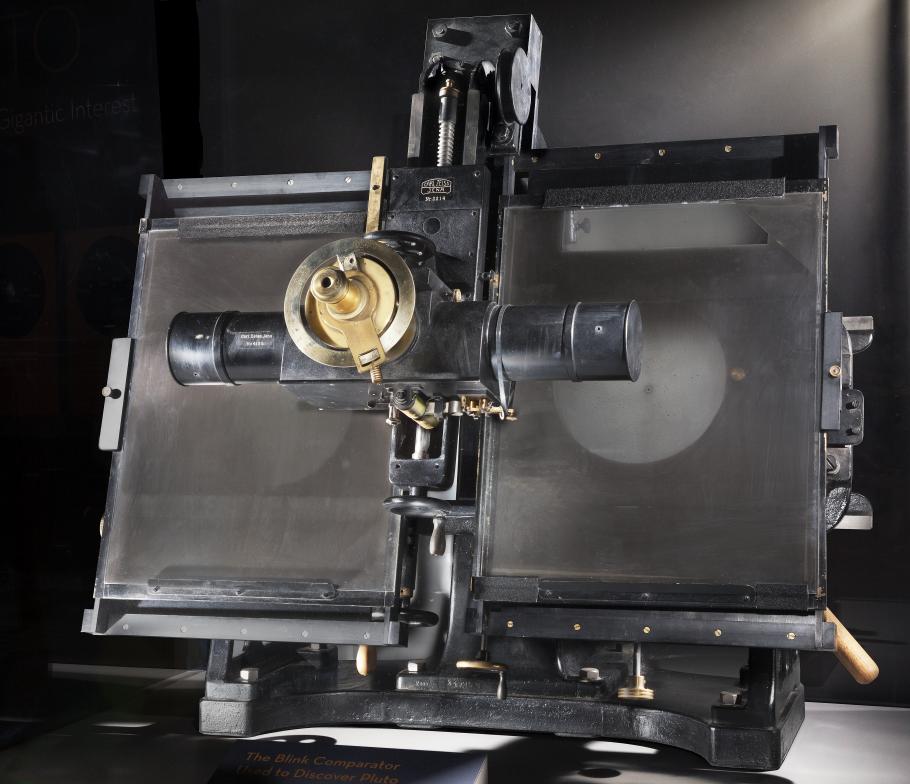
Photograph of a blink comparator. (Smithsonian National Air and Space Museum, 2015)
Pluto was found using this blink comparator which shows how astronomy has been influenced by technological advancements.